How Much Do Solar Panels Cost in the UK?
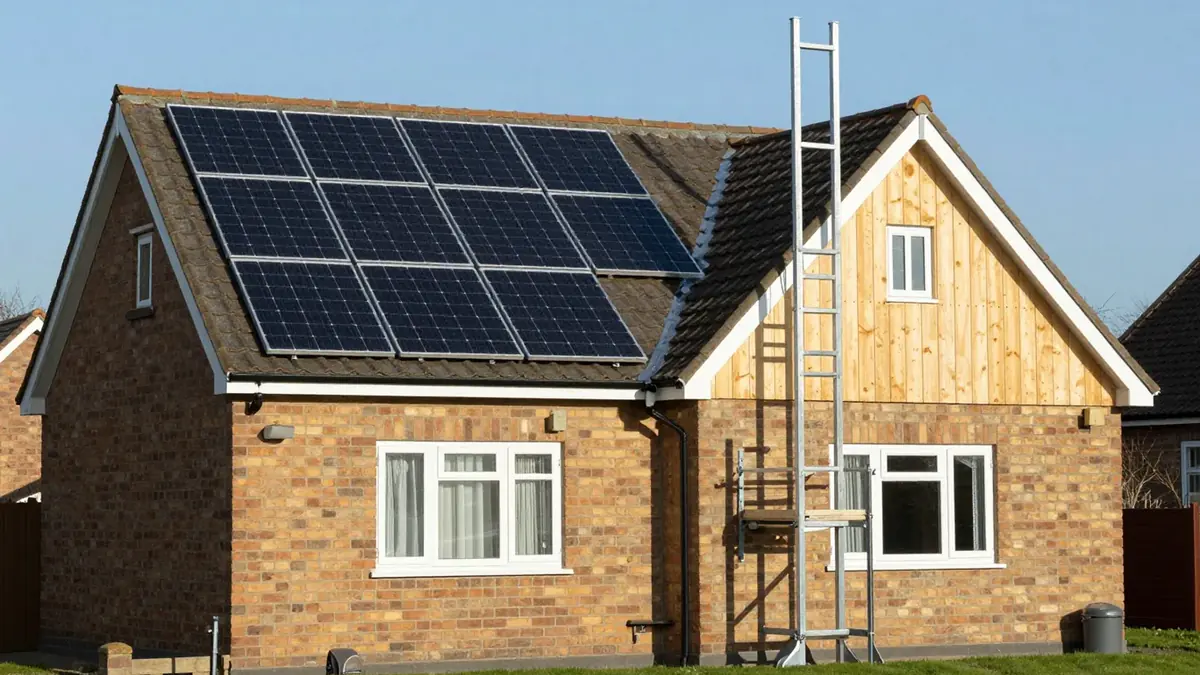
Government data for 2025/26 shows a typical home solar system costs around £1,700 to £1,800 per kW installed. A 4 kW system is therefore roughly £7,000 to £7,500 before any grants. However, quotes vary, so compare itemised offers from MCS-certified installers.
How much solar panels cost per kW
The most useful way to price solar is per kW, because it lets you compare small and large systems fairly.
DESNZ publishes small-scale solar cost data from the MCS database. For example, in 2025/26 the median was £1,780 per kW for systems up to 4 kW. For 4 kW to 10 kW systems, the median was £1,697 per kW.
Larger systems cost less per kW because some costs stay fixed. For example, the visit and the scaffold cost much the same for six panels or twelve. As a result, adding panels is cheaper than adding a second job.
What that means in pounds
Multiply the per kW figure by the system size. The sums below use the 2025/26 medians, because they are rounded. Real quotes will differ.
| System size | Median £ per kW | Rough total |
|---|---|---|
| 4 kW | £1,780 | about £7,100 |
| 6 kW | £1,697 | about £10,200 |
| 8 kW | £1,697 | about £13,600 |
These are national medians, not quotes. Your price could be higher or lower. Moreover, the mean was higher than the median, at £2,096 per kW for systems up to 4 kW. A few expensive jobs pull the average up.
Which?, citing the Energy Saving Trust, gives around £7,600 for a typical 4.5 kWp system. Installed costs fell by about 7% between 2024/25 and 2025/26 for systems up to 4 kW. Check the date on any figure you read, since prices move.
Which size is typical
Most UK homes fit a smaller system, since roofs are limited. In the 2025/26 MCS records, about 61% of domestic installs were up to 4 kW. Which? and the Energy Saving Trust use 3.5 to 4.5 kWp as the typical example.
Roof space and use set the right size for you. A bigger array costs more in total, although the cost per kW drops. Our guide to the solar panel installation service explains how an installer judges your roof.
What changes the total
Several things move a quote up or down, because most depend on your roof and the extras you choose.
- Roof type and access. A steep or tall roof may need more scaffold.
- Panel quality. Higher-efficiency panels cost more per kW.
- Inverter choice. String, micro and hybrid inverters differ in price.
- Battery. Adding storage raises the total, so it should be a separate line.
- Extra work. A new consumer unit or cable run adds to the bill.
Our solar inverters guide covers the inverter choice in more detail. In addition, a battery-ready design can save money later if you add storage.
VAT, grants and timing
VAT is a real saving at the moment because the rate is zero. Installing solar panels in a home is currently VAT-free (0%) until 31 March 2027, according to HMRC Notice 708/6. From 1 April 2027 the rate is due to revert to 5% under current legislation.
Grants are narrow, so do not assume one applies. However, low-income households in England may qualify for the Warm Homes: Local Grant through their council. Their home must be in EPC band D to G. For most homeowners it is not a route to a free system.
ECO4 ends on 31 December 2026 with no successor, and the Great British Insulation Scheme has closed. Therefore do not plan around either. Meanwhile some councils run group-buying schemes, now branded Switch Together, so check whether yours is open.
How to read a solar quote
A good quote lists each part and each task, so you can see what you pay for and why. Look for these lines:
- Total system size in kWp and the number and model of panels.
- Inverter make and model.
- Mounting system and scaffold.
- Electrical work, including any consumer unit change.
- Monitoring, commissioning and the MCS certificate.
- Warranty terms in writing for the panels, the inverter and the workmanship.
- VAT shown as its own line.
If a quote leaves an item out, ask whether it is included. Our guide to MCS certified installations explains why the certificate matters. Specifically, you need it to claim Smart Export Guarantee payments.
Payments and deposits
Many people ask how much to pay up front. The answer depends on the installer’s consumer code, because each code sets its own limits.
RECC guidance says, for example, that a deposit should be no more than 25% of the final contract price. Installers who are RECC members follow that code. Ask the installer whether your deposit and workmanship warranty are insurance-backed, and which code covers them.
Planning rules can also affect cost. In England, most rooftop solar on houses and flats does not need planning permission, although conditions apply. The rules changed on 27 August 2026, therefore ask your installer to confirm for your home.
Costs that sit outside the quote
Some costs do not appear on the quote. They are worth planning for, because they affect the real return.
For example, an inverter may need replacing during the life of the panels. Ask the installer what the inverter warranty covers and for how long. Similarly, ask what happens if scaffold must be rebuilt for a later repair.
Insurance is another item. Tell your home insurer about the panels, since a change to the roof may alter your cover. Meanwhile, keep the MCS certificate and the paperwork safe, because you will need them for export payments and for a future sale.
Earning something back
Panels save money by cutting the power you import. They can also earn from surplus power sent to the grid, since each supplier sets its own Smart Export Guarantee rate. That rate must be above zero.
Our guide to the Smart Export Guarantee with a home battery explains how to read the terms. Furthermore, our piece on whether solar batteries are worth it shows how to test the sums with a battery.
Charging an electric car adds demand that panels can meet, so see our guide to solar EV charging for how that works. A battery can also help, and our overview of the Tesla Powerwall 3 and its alternatives compares options.
Why location matters to the sums
Sunshine and roof types differ across the UK. The PVGIS tool from the EU Joint Research Centre models a 4 kWp array on a south-facing roof at 35 degrees. These are estimates, not promises, because every roof differs.
Liverpool is modelled at about 3,860 kWh a year. Terraced homes are 37.9% of households there, while Article 4 directions cover most of the city’s 36 conservation areas. Therefore check planning rules first. See our page on solar panel installers serving Liverpool.
Glasgow is modelled at about 3,410 kWh a year, although this is lower than the English cities. Council data from 2020 suggests about 73% of homes are flats. Home Energy Scotland no longer funds standard solar panels, so check the rules. Read about solar and battery storage in Glasgow.
Coventry comes out at about 3,946 kWh a year, while terraced homes are 39.9% of households. That is the highest terraced share among the Midlands cities we checked. Our page on solar panel installers in Coventry has more detail.
Southampton is modelled at about 4,255 kWh a year, while this is the highest here. Flats are 41.5% of households, so building permission can matter. We cover this on our page for solar panels in Southampton.
Getting a fair price
Therefore start by knowing your rough size and what you want included. Then ask for at least two quotes with the same specification. Compare them line by line, not by the total.
Solar Base Energy is a free matching service, and we do not install panels ourselves. However, you can tell us about your home through the quote form, and we match you with an MCS-certified installer. Our solar and battery packages page explains what a bundle can include.
Sources
Frequently asked questions
How much do solar panels cost in the UK? +
Government data for 2025/26 puts the typical cost of a small home system at around £1,700 to £1,800 per kW installed. That is roughly £7,000 to £7,500 for a 4 kW system before any grants.
Is there VAT on solar panels? +
Installing solar panels in a home is currently VAT-free (0%) until 31 March 2027. From 1 April 2027 the rate is due to revert to 5% under current legislation.
Why do two solar quotes differ so much? +
The scope often differs, because one quote may include scaffolding, a better inverter or a battery-ready design. Therefore compare the line items, not only the total.
How much deposit should I pay? +
Installers who are RECC members follow a consumer code that says deposits should be no more than 25% of the contract price. Ask any installer who the consumer code is and what it covers.