MCS Certified Solar Installers
MCS certified solar installers work to UK quality standards for solar panels and home batteries. Because of this, we match you only with MCS-certified firms, so your system can qualify for Smart Export Guarantee payments.
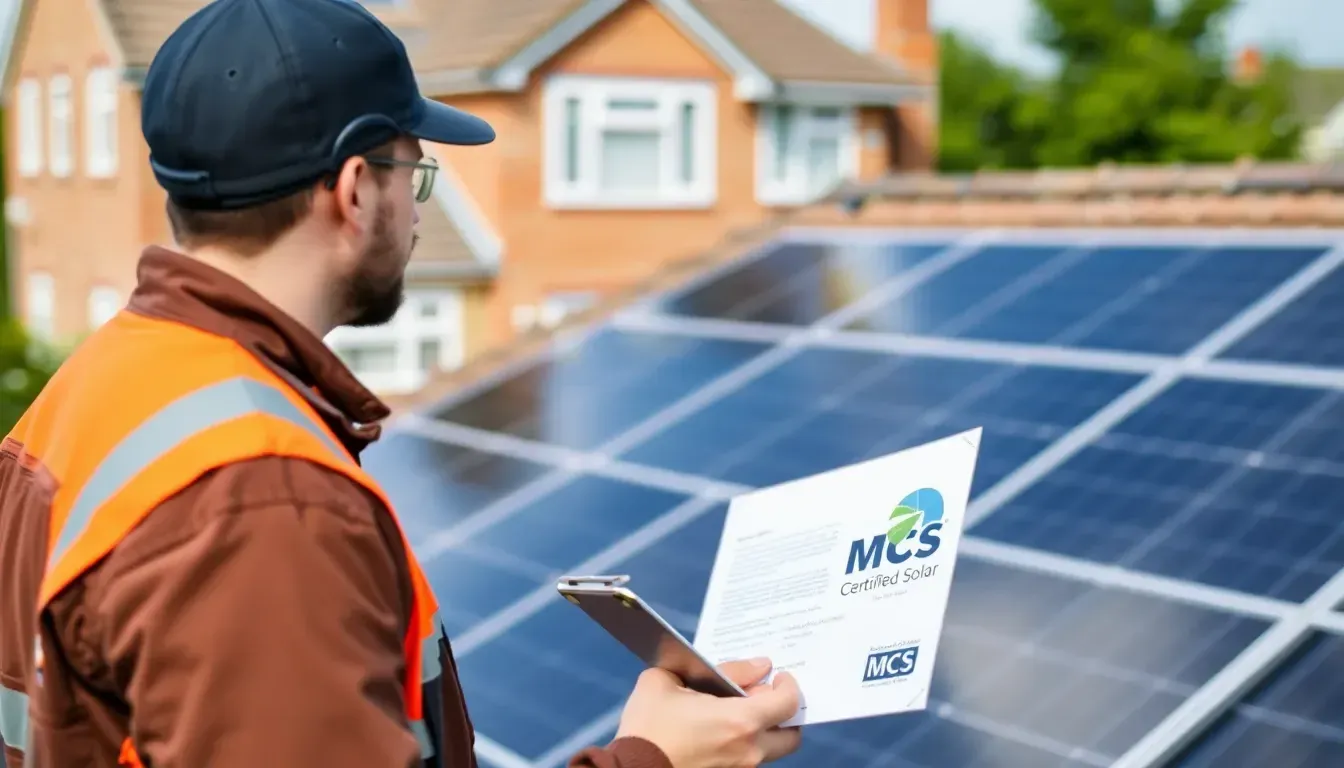
MCS, the Microgeneration Certification Scheme, is the UK quality mark for small-scale renewable installers and products. It covers solar panels, battery storage and heat pumps, although this page focuses on solar and batteries. Consumers can search for certified installers on the MCS website.
However, the badge matters for more than quality. You need MCS certification to claim many incentives, including Smart Export Guarantee payments. Therefore choosing an MCS installer protects both your system and your income from it.
What MCS certification means
An MCS installer has been assessed against published installation standards, and their products must also be certified. The scheme sets rules for design, fitting and the paperwork you receive afterwards. As a result, certified firms work to the same published standards.
For solar panels the standard is MIS 3002. For home batteries it is MIS 3012, which applies to systems up to 50 kW. Since MCS publishes both, you can read what the installer must follow.
MCS certification is also needed for many incentives. For example, the Boiler Upgrade Scheme requires it, although that scheme pays for heat pumps and biomass boilers, not solar. Solar panels and batteries are not covered by it.
Why it matters for the Smart Export Guarantee
Under the Smart Export Guarantee, energy suppliers pay you for surplus solar electricity that you send to the grid. However, your system must be MCS-certified to claim, and you need a smart meter or another half-hourly export meter. The scheme covers Great Britain, not Northern Ireland.
Each supplier sets its own rate, but it must be above 0p. In October 2026, for example, Octopus's open tariff paid 4.1p per kWh. In contrast, British Gas's tariff for non-customers paid 3p per kWh.
Check current rates before you choose, because suppliers change them. Some pay more to their own import customers, so compare the terms. Our guide to the Smart Export Guarantee with a battery explains how storage changes the picture.
You apply directly to a supplier with a Smart Export Guarantee tariff. You cannot be on the older Feed-in Tariffs as well, therefore check which scheme an older system uses before you apply.
You do not need to switch your import supplier for a basic tariff, although some premium tariffs do require it. Compare the open tariffs first. Then look at the premium ones if you are happy to switch.
How to check an installer is MCS certified
Start with the MCS website, which lets you search for certified installers. Then ask the installer for their certificate and check that it covers the work you want. Because solar panels and batteries are separate technologies, confirm both if you need both.
Also check the consumer code, since RECC members follow a code that says deposits should be no more than 25% of the contract price. Ask whether your deposit and workmanship warranty are insurance-backed, as insurance terms vary. Get the answers in writing.
Be wary of any firm that cannot show a certificate. Similarly, treat a verbal claim of MCS status as unproven until you have seen the paperwork. Ask for the certificate before you pay a deposit.
Keep a record of your checks. For example, save the MCS listing and the certificate number with the date. Then you can show your supplier what you checked if questions arise later.
What MCS does not cover
| Topic | Position |
|---|---|
| MIS 3002 | The MCS standard for solar panel installations |
| MIS 3012 | The MCS standard for home battery installations |
| PAS 63100 | BSI guidance on siting batteries in homes; MCS says it has no standing in UK regulations |
| Planning permission | Set by your nation's planning rules, not by MCS |
| Electrical safety paperwork | Building regulations apply; ask what certificates you receive |
MCS does not replace planning or building rules. For instance, listed buildings need consent whatever the installer holds. Therefore check the council's rules as well as the certificate.
While the Warm Homes: Local Grant in England needs installers certified under PAS 2030 or MCS, households apply through their council. It targets low-income households in lower-rated (EPC D to G) homes. It is therefore not a way to get a free system for most homeowners.
Batteries and MCS
Although PAS 63100 is BSI guidance rather than an MCS standard, home batteries should be sited following it. In practice that means outdoors or in a garage where possible, and not in bedrooms or escape routes. Your installer should explain where yours will go.
MIS 3012 refers to the IET Code of Practice for electrical energy storage, which recommends PAS 63100. Therefore the siting guidance reaches installers indirectly, even though MCS says PAS 63100 has no standing in regulations.
If you already have panels, you can add storage later, yet the installer must still follow the battery standard. Our guide on how to add a battery to existing solar covers the main checks. See also our battery storage page for more on what to expect.
Mistakes to avoid when comparing quotes
A common mistake is to treat the lowest price as the best deal. However, a cheap quote may leave out scaffold, the export meter or the paperwork. Therefore compare like with like.
Another mistake is to pay a large deposit early. Since RECC guidance says deposits should be no more than 25%, question any firm that asks for more. Also be careful with pressure to sign on the day.
What a good quote should list
Specifically, your quote should name the installer's MCS certification and say which standards apply. It should list the equipment, the system size and the export meter arrangements. It should also state the payment schedule and the warranty terms.
Ask each firm how the MCS certificate reaches you after installation, because you will need it when you apply to a supplier for export payments. Keep copies with your other handover documents. For instance, store them with the warranty papers.
Also ask for the model names of the panels, inverter and battery. Because MCS also certifies products, the names let you check each item against the scheme. Keep the datasheets with your records.
How our matching works
Solar Base Energy is a free matching service, not an installer. Because of this, we only pass your details to MCS-certified firms. There is no obligation to go ahead.
Homeowners in Sheffield, Cardiff and Liverpool use the same process. Meanwhile, you can read about solar panel installation for a wider view. You can also see how smart tariff optimisation fits with export payments.
For hardware choices, read our guide to the best solar batteries in the UK. However, the installer's survey decides what suits your home, because roofs and usage differ.
Sources
- MCS: Information for consumers (checked 10 October 2026)
- MCS: Update on PAS 63100 and the IET Code of Practice (checked 10 October 2026)
- GOV.UK: Smart Export Guarantee (checked 10 October 2026)
- Ofgem: Smart Export Guarantee (checked 10 October 2026)
- Octopus Energy: Smart Export Guarantee (checked 10 October 2026)
- RECC: Consumer guidance (checked 10 October 2026)
Frequently asked questions
Do I need an MCS certified installer? +
You need one to claim Smart Export Guarantee payments and to access many other incentives. It is also the main UK quality mark for solar installers. Because of this, we only match you with MCS-certified firms.
What does MCS certified mean? +
It means the installer and the products meet published UK standards for small-scale renewables. For solar panels the installation standard is MIS 3002, while for batteries it is MIS 3012.
How do I check an installer is MCS accredited? +
Search for them on the MCS website and ask for their certificate. Check that it covers the technology you want, such as panels or batteries, because the scope can differ.
Do I need MCS to get paid under the Smart Export Guarantee? +
Yes. Your installation must be MCS-certified, and you need a half-hourly export meter, which is usually a smart meter. Suppliers then set their own rates, although each must pay above 0p.
Does Solar Base Energy charge for a match? +
No. Our matching service is free and carries no obligation. Complete the short form to get started, since there is nothing to pay.
Get a free battery storage quote
Tell us about your home and your current setup, and we'll match you with an MCS-certified installer. You get a free, no-obligation quote, and there are no phone calls because we reply by email.
Get Your Free Quote