EV Charger Installation for Solar Homes
EV charger installation works best when the charger, solar panels and home battery are planned together. Because of this, we match you with an MCS-certified installer who can fit a smart charger that uses your own solar power.
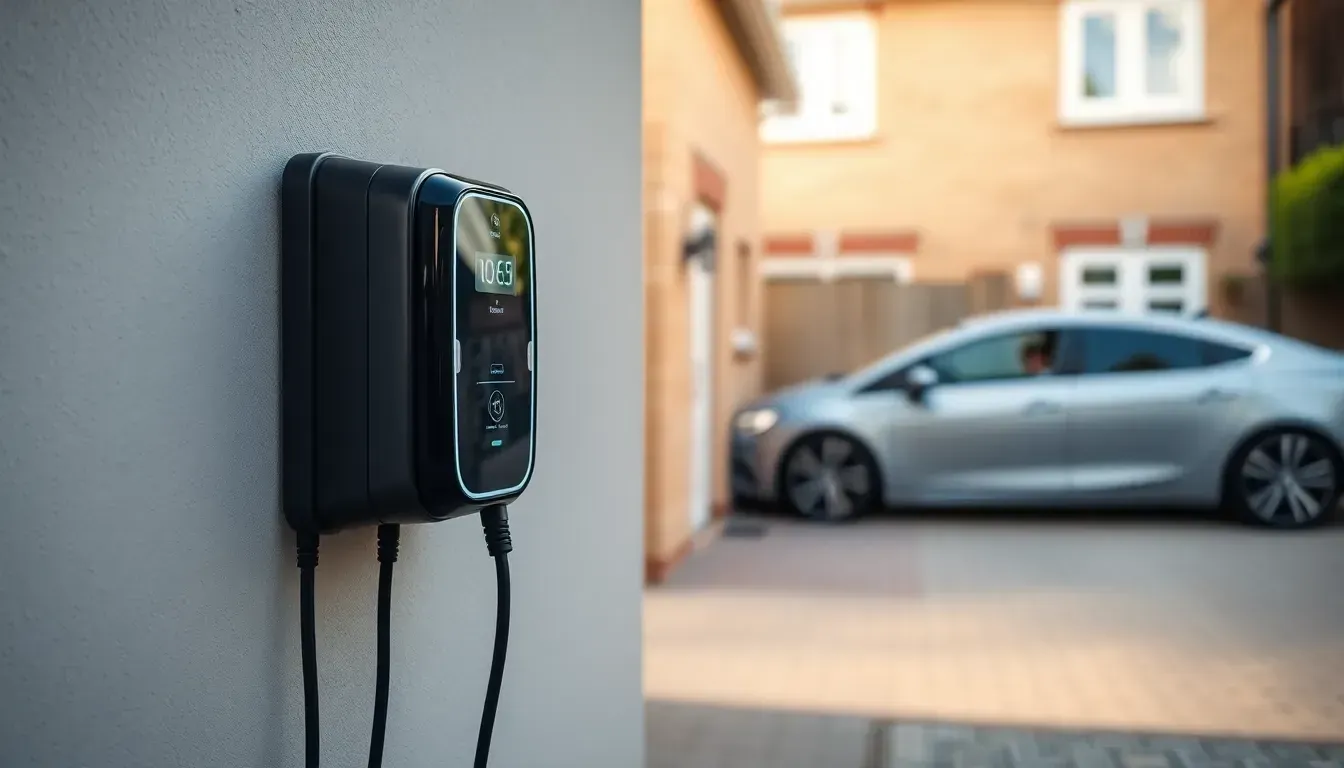
EV charger installation at home means a wall-mounted charge point wired to your consumer unit. Pairing it with solar panels lets you charge the car from your own generation. A home battery stores spare daytime power for an evening or overnight charge.
However, a charger does not make any power itself. It only decides when the car draws electricity and how fast. Therefore the real saving comes from timing, because daytime solar and cheap overnight rates cost less than peak grid power.
How solar-ready charging works
Some smart chargers can follow your solar output. They raise the charging speed when the panels send out plenty of power and lower it when a cloud passes. Meanwhile the rest of the house still gets the power it needs.
A battery adds a second option. Spare solar goes into the battery during the day, and the car can draw on it later. For example, a household that is out at work can still charge from its own power at night.
Specifically, the charger needs a way to know your solar output. Depending on the equipment, this can come from a meter clamp, the inverter or the battery system. Therefore tell the installer about your panels before they choose a model.
Who it suits
Because the car becomes another use for power you already make, a solar-ready charger suits households that have panels and a battery. It also suits homes with off-street parking and a driver who plugs in most days. A roof that gets good sun adds to the benefit.
It suits some homes less well. If the car is away all day and you charge only at night, panels alone will do little for it. However, a battery or a cheap overnight tariff can still bring the cost down.
Renters and flat owners have extra steps, because the landlord or freeholder must agree to the work. Nevertheless, government grants exist for them, as covered below. Ask for permission early, since the cable route may cross shared areas.
Our guide to whether solar batteries are worth it sets out how to weigh up a battery. Similarly, our battery storage page explains what a battery does for the whole home.
Ways to charge at home
| Option | Works best when | Watch for |
|---|---|---|
| Solar power only | The car is at home in daylight | Cloudy days and empty driveways reduce the benefit |
| Solar plus battery | You charge in the evening or overnight | A larger battery costs more |
| Cheap overnight tariff | You can plug in after dark | Rates and windows differ by supplier |
| Standard grid power | You need a quick top-up | Peak-rate power costs the most |
Tariffs matter as much as hardware. In October 2026, for example, Intelligent Octopus Go charged 7.6p per kWh overnight for eligible cars and chargers. By comparison, the Ofgem price cap from 1 October to 31 December 2026 averages about 26p per kWh for electricity.
Check each supplier's page for current rates, because they change often. Smart tariffs need an eligible car and charger, therefore confirm compatibility before you buy. If you want a battery too, read our guide to the best solar batteries in the UK.
Planning the charge point
Location matters. The charge point should sit close to your parking space and, ideally, to the consumer unit, since a shorter cable run can cost less. Also check the spot has a good Wi-Fi or mobile signal, because smart features need a connection.
Think about future needs too. For instance, a second car may need its own charger or a shared one. Similarly, panels or a battery added later should be able to link to the same unit.
Costs and what drives them
We do not quote a typical charger price here, because we found no reliable national figure. Ask each installer for a fixed written quote instead. Costs differ since each home has a different layout.
Several things drive the price. These include the distance from the consumer unit to the charge point, the cable route and whether the consumer unit needs work. Furthermore, the features of the charger and any link to your solar system also matter.
Running costs depend on your tariff, because the unit rate sets the cost of each charge. The Ofgem cap is reset each quarter, so the figure above will change. Check the latest rate before you plan around it.
Government chargepoint grants of up to £500 are open to renters, flat owners and some on-street households until 31 March 2027. However, home-owners with a driveway are not currently covered. Check the GOV.UK page for the latest rules, since schemes change.
Rules and standards that apply
Home chargepoints sold in Great Britain since mid-2022 must be smart. Under the Electric Vehicles (Smart Charge Points) Regulations 2021, they need off-peak charging hours set by default, although you can change them. They must also meet security requirements.
Electrical work in a home has to meet building regulations. In England, Approved Document P covers electrical safety, and a registered installer normally handles the paperwork and certificates. However, Scotland uses building standards instead, so ask your installer which applies.
Your installer also tells your network operator about the new load where required. MCS covers solar panels and batteries, so ask whether the firm fitting the charger is registered for electrical work. This matters because registration lets them certify the job themselves.
What a good quote should list
Specifically, a good quote names the charger make and model and says which smart features it has. It shows the cable route, any work on the consumer unit and who files the notifications. It also states the warranty terms in writing.
Ask about aftercare as well. For example, find out who you call if the app stops working or the charger shows a fault. Also check how long the warranty runs and what it excludes.
If you plan to add panels or a battery later, say so up front. For instance, ask whether the charger can work with a battery added after the first install. Our guide to the Tesla Powerwall 3 in the UK shows how one popular battery fits into a wider system.
How our matching works
Solar Base Energy is a free matching service, not an installer. Because of this, we pass your details to an MCS-certified installer rather than doing the work ourselves. You tell us about your home, your car and any panels or battery on the short quote form.
There is no obligation to go ahead. The installer, not us, surveys your home, prices the work and fits the equipment. Homeowners in places such as Cardiff can start the same way, while those planning both can read about solar and battery packages.
After the charger is in, smart tariff optimisation and smart energy monitoring help you see and trim the running cost. Households in Manchester and Glasgow can compare local options on the same form, since the process is the same across the UK.
Sources
- GOV.UK: Electric vehicle smart charge points regulations (checked 10 October 2026)
- GOV.UK: Electric vehicle chargepoint grants (checked 10 October 2026)
- Octopus Energy: Intelligent Octopus Go (checked 10 October 2026)
- Ofgem: Price cap changes, 1 October to 31 December 2026 (checked 10 October 2026)
- GOV.UK: Electrical safety, Approved Document P (checked 10 October 2026)
Frequently asked questions
Can I charge my electric car from solar panels? +
Yes, although only while the sun is shining and the car is plugged in. A battery can store spare solar power, so the car can use it later. Your installer can set the charger to favour solar first.
Can I add a charger to solar panels I already have? +
Usually, yes. The installer checks your consumer unit and whether the charger can work with your inverter, since not all models link up. A battery that is already fitted can often share the same setup.
Is there a government grant for a home charger? +
Grants of up to £500 are open to renters, flat owners and some on-street households until 31 March 2027. However, home-owners with a driveway are not currently covered. Check the GOV.UK page for the latest rules.
Does the charger work during a power cut? +
Backup power is an extra feature, because many solar and battery systems switch off during a power cut. Ask your installer whether the system you are quoted includes it.
How do I start? +
Complete our short quote form with details of your home and car. Once we match you, an MCS-certified installer will survey your property and quote, while you stay free to decline.
Get a free battery storage quote
Tell us about your home and your current setup, and we'll match you with an MCS-certified installer. You get a free, no-obligation quote, and there are no phone calls because we reply by email.
Get Your Free Quote