Charging an EV With Your Own Solar Panels
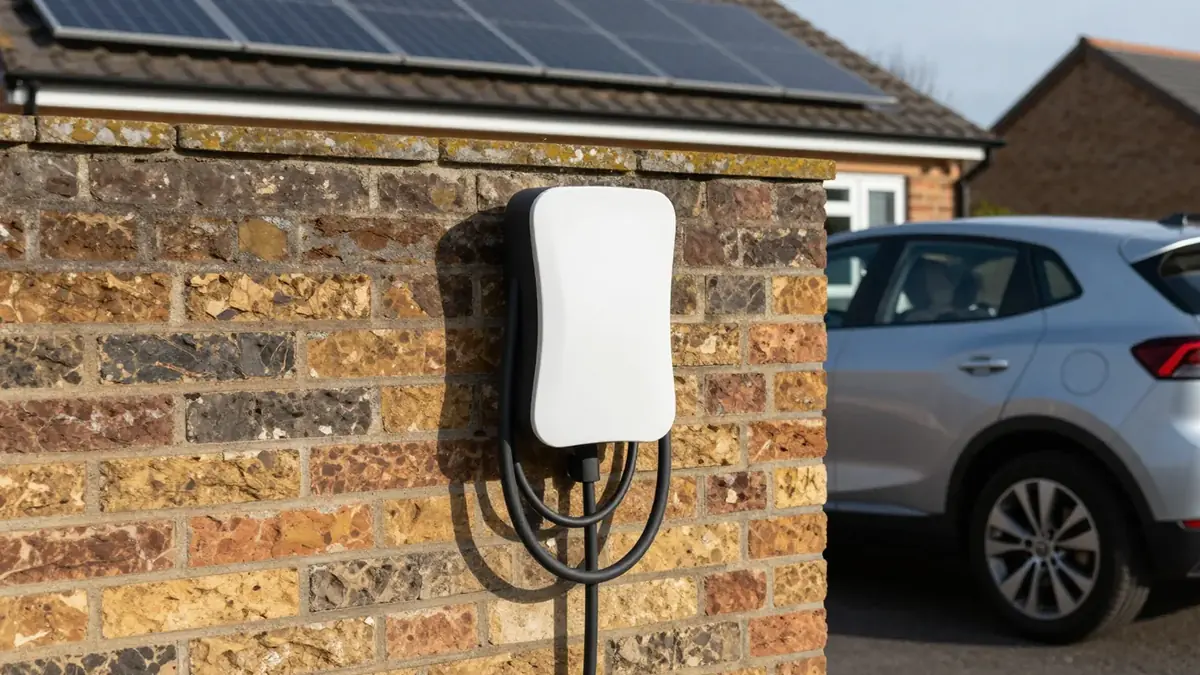
Solar EV charging means using electricity from your own roof to charge your car. A solar-diverting charger sends spare panel power to the car, and a battery can store extra for the evening. Because the sun is not always out, most homes still top up from the grid.
How solar EV charging works
Panels make direct current, and the inverter turns it into the power your home uses. The home uses what it needs first. However, whatever is left over would normally go to the grid.
A solar-diverting charger changes that. It watches how much spare power your roof is making and sends that to the car. As a result, the car charges from your panels instead of selling that power at a low export rate.
Not all chargers do this. Some only charge at a fixed speed. Therefore, ask any installer whether the charger can vary its output with the sun. Our page on EV charger installation covers what the work involves.
Why the speed of charging matters
A home chargepoint can draw more power than a small roof makes. Panels give a modest flow of power, while a car can take much more than that. For this reason, a solar-diverting charger throttles its output down to match the sun.
Charging at the pace of the sun is slow. It suits a car that sits on the drive for most of the day. However, it suits a commuter less well, because the car is away while the sun is high.
That is where a battery or a cheap overnight rate fills the gap, as the next sections show. Neither is essential, but both widen the hours when charging makes sense.
The mileage maths, step by step
You can estimate how much solar power your car needs in three steps. First, find how many miles you drive in a year. Second, find your car’s efficiency in miles per kWh, which is in its specification. Third, divide the miles by that efficiency.
For example, suppose a car drives 7,000 miles a year at 3.5 miles per kWh. That would need about 2,000 kWh a year. These are illustrative numbers, not a promise, so use your own.
Next, compare that with what your roof can make. For instance, the EU PVGIS tool estimates that a 4 kWp array in Bristol makes about 4,092 kWh a year. A roof in Newcastle makes about 3,793 kWh.
Only part of that power will line up with the hours the car is home. Meanwhile, the rest goes to the house, the battery or the grid. Our guide on how many solar panels you need shows how to size the roof for a full household, car included.
What a battery adds
A battery stores midday solar power for later. A driver who is out until six can then charge the car in the evening. That works if the battery is large enough.
Size matters here because a car can take a large amount of energy in one session. A small battery therefore runs out quickly. Our guide to solar battery size shows how to work out how much you need.
You can also buy panels and a battery together. For example, our page on solar and battery bundles explains what a package includes. For homes that already have panels, the guide on how to add a battery to existing solar is the place to start.
What to expect on dull days
Panels still make power under cloud, but the output is lower. In winter the days are short as well. Therefore, a solar-diverting charger will often find too little spare power to charge the car at all.
On those days the car needs the grid. A smart time-of-use tariff can make that cheap. For example, Intelligent Octopus Go charged 7.6p per kWh from 23:30 to 05:30 in October 2026. It also listed up to six hours a day of smart charging off-peak.
In contrast, the Ofgem price cap averages about 26p per kWh for electricity from 1 October to 31 December 2026. The gap is large, so a cheap overnight rate is worth having. Our page on smart tariff optimisation explains how to choose one. Rates change each quarter, so check the supplier’s page before you decide.
Smart chargers and the rules
Home chargepoints sold in Great Britain since mid-2022 must be smart, with off-peak charging set by default. This helps with a time-of-use tariff, since the charger already understands schedules. It does not by itself divert solar power, so ask about that separately.
Electrical work in a home has to meet building regulations. A registered installer normally handles the paperwork and gives you the certificates. However, the rules differ in Scotland.
Grants for an EV chargepoint
Government chargepoint grants of up to £500 are available to renters, flat owners and some on-street households until 31 March 2027. Home-owners with a driveway are not currently covered. Because the rules can change, check the GOV.UK page before you apply.
Solar panels in a home are currently VAT-free (0%) until 31 March 2027. From 1 April 2027 the rate is due to revert to 5% under current legislation. Similarly, home batteries, including ones fitted on their own, are VAT-free until that date.
Does it pay back?
It depends on the car, the miles and the rates you pay. Our guide to solar panel payback shows the method. In short, the more of your own solar power the car uses, the less you buy from the grid.
Regional yield matters too. PVGIS puts a 4 kWp array in Leicester at about 3,923 kWh a year, and in Hull at about 3,988 kWh. Households comparing solar installers in Leicester or battery storage serving Hull will see small differences from the south coast. However, panel angle and shading can matter more than the city.
Meanwhile, for homes in the south west, our page on solar and battery quotes in Bristol covers local housing and roof questions. If you live in the north east, see the page on solar panels and batteries in Newcastle.
Questions to ask an installer about EV charging
A quote for panels and a charger should spell out how the two work together. Ask the following before you sign.
- Can the charger divert spare solar power, and how does it measure it?
- Does the charger work with the battery and inverter in the quote?
- Can I set a cheap overnight window as a fallback on dull days?
- Does the quote cover the electrical work, the certificates and the commissioning?
- Is a smart meter in place if I want export payments?
To claim Smart Export Guarantee payments, your system must be MCS-certified, and you need a smart meter or another half-hourly export meter. Because a solar car uses much of your own power, you may export less. Even so, the export rate is worth knowing, since it sets the value of power you do not use.
A worked method for your own home
Start with the miles, then convert them to kWh using your car’s efficiency. Next, estimate how many of those kWh you could charge during daylight, and how many at night. Finally, price the daylight kWh at the export rate you give up, and the night kWh at your cheap overnight rate.
That method keeps the figures honest, because each step uses a number you can check. It also shows which part of the plan carries the most weight. For many households, the answer is the overnight tariff, not the panels.
Choosing the equipment
Look for a charger that can follow the sun, and ask how it measures spare power. For example, it may use a sensor on the supply cable or a link to the inverter. Both approaches suit different homes, so ask which one your installer would use.
Compare home batteries too, because not all of them work well with a charger. Our guide to the best solar batteries in the UK explains what to compare.
Solar Base Energy is a free matching service. Specifically, we match you with an MCS-certified installer through our quote form, and we do not install anything ourselves. Tell the installer you own an EV, so the quote covers the charger, the panels and the battery together.
Sources
Frequently asked questions
Can I charge my electric car from solar panels? +
Yes, you can charge an EV from your own panels, either directly or through a battery. A solar-diverting charger sends spare panel power to the car instead of exporting it. On dull days the car can still charge from the grid.
Do I need a battery to charge my car with solar? +
No, a battery is optional. However, it lets you store midday solar power and charge the car in the evening, which suits drivers who are out during the day.
Are there grants for a home EV chargepoint? +
Government chargepoint grants of up to £500 are available to renters, flat owners and some on-street households until 31 March 2027. Home-owners with a driveway are not currently covered.
What happens when the sun is not shining? +
The charger can top up from the grid, ideally at a cheap overnight rate. A smart time-of-use tariff such as Intelligent Octopus Go charged 7.6p per kWh overnight in October 2026, so check the current rate.