How Many Solar Panels Do I Need?
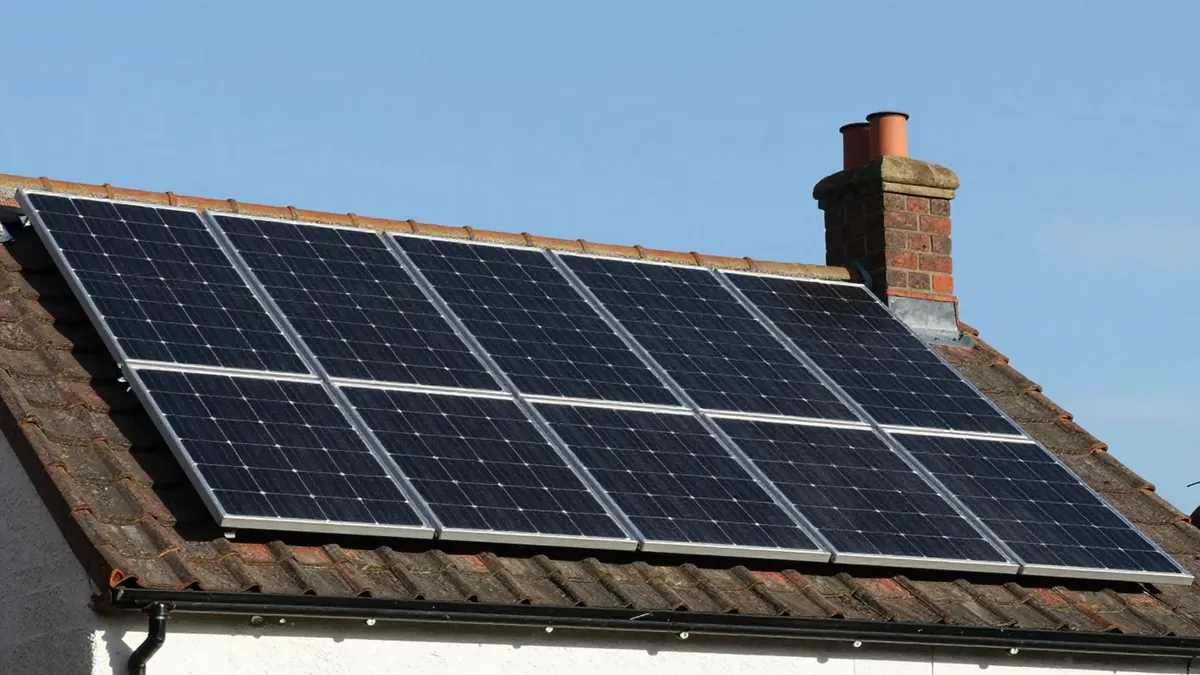
Most UK homes fit a solar system of about 3.5 to 4.5 kWp. At 400 W per panel, that means roughly 9 to 11 panels. Your own number depends on your yearly electricity use, your roof space and the sunshine where you live. The method below shows how to work it out, because no single count suits every home.
Start with kWp, not panel count
Installers size a system in kilowatts peak, or kWp. This is the total rated output of all the panels together. Panel count only follows once you know the wattage of each panel, since larger panels need fewer units.
The sum is simple. Multiply the number of panels by the watts per panel, then divide by 1,000. For example, 10 panels of 400 W make a 4 kWp system. If you choose 450 W panels, you need fewer of them for the same output.
Because panel wattage keeps changing, always compare quotes in kWp. Two quotes with different panel counts may offer the same size. Our guide to what solar panels cost in the UK uses the same measure.
What is typical in the UK
Government records give a good picture of what people buy. For instance, in the 2025/26 DESNZ data, 107,137 domestic installs were 0 to 4 kW. A further 64,487 were 4 to 10 kW. That means about 61% of domestic installs were 4 kW or smaller.
Which? and the Energy Saving Trust both use 3.5 to 4.5 kWp as a typical example. Therefore a 4 kWp system makes a sensible starting point for most houses. You can then move up or down from there.
Step one: find your yearly electricity use
Look at your electricity bill or your supplier’s app. Find your total use for the last 12 months in kWh. A smart meter makes this easy, because it records the figure for you.
Use a full year, not one month, because winter and summer use differ. Furthermore, think about what will change soon, such as an electric car or a heat pump. Those add to your demand, so a system sized only for today may feel small within a few years. Tell your installer about any plans, so the layout leaves room.
Step two: find the yield where you live
Sunshine varies across the UK, so location matters. The EU’s PVGIS tool models the yield of a 4 kWp system for any address. We ran it for city-centre coordinates, with a south-facing roof at a 35 degree tilt and 14% system losses.
| City | Modelled yearly output of 4 kWp | Output per kWp |
|---|---|---|
| Sheffield | 3,787 kWh | about 947 kWh |
| Nottingham | 3,880 kWh | about 970 kWh |
| Cardiff | 4,167 kWh | about 1,042 kWh |
| Plymouth | 4,488 kWh | about 1,122 kWh |
These are modelled estimates, not guarantees, because your roof angle, direction and shading will change them. Still, the table shows a real spread of about 18% between Sheffield and Plymouth.
Step three: do the sum
Divide your yearly use by the yield per kWp. The result is the system size that would match your total use over a year. Here is a worked example for one home, using a made-up home that uses 3,500 kWh a year.
In Sheffield, 3,500 divided by 947 gives about 3.7 kWp. In Plymouth, 3,500 divided by 1,122 gives about 3.1 kWp. The same home needs a smaller array in the sunnier city. This is an illustration of the method, not a quote.
The next table applies the Sheffield yield to three made-up homes. It assumes 400 W panels, and it rounds to the nearest whole panel.
| Yearly use | System that matches it | Panels at 400 W |
|---|---|---|
| 2,500 kWh | about 2.6 kWp | about 7 |
| 3,500 kWh | about 3.7 kWp | about 9 |
| 4,500 kWh | about 4.8 kWp | about 12 |
Matching your yearly total does not mean you use all of it yourself. Solar makes most power at midday, while many homes use more in the evening. As a result, you will export some power and still buy some from the grid.
The roof sets the limit
Your sum may call for more panels than your roof can hold. South, east and west roofs all work, though a south roof makes the most. Chimneys, dormers, roof windows and shade from trees or buildings all reduce the usable area.
Direction matters for the sum too. The PVGIS figures above assume a south-facing roof. A roof facing east or west usually makes less power per panel. You may need more panels to reach the same yearly output.
Therefore ask the installer to state the expected output for your actual roof, not a generic one.
A surveyor checks these points on site, because a photo cannot show them all. Do not rely on a photo or an online map for the final layout. Ask for a drawing that shows where each panel will sit.
House type changes the picture too. According to the 2021 Census, 38.0% of Sheffield households live in semi-detached homes. See solar panel and battery installers in Sheffield for the local detail.
In Cardiff, 29.6% live in terraced homes and 26.5% in flats, so roof access is more varied. Therefore our page for battery storage quotes in Cardiff explains more.
Too many panels, or too few
An oversized array can leave you with surplus power you cannot use. The Smart Export Guarantee pays for what you export, but each supplier sets its own rate. The rate has to be above zero, yet it varies a lot, so compare tariffs.
To claim, the installation needs MCS certification, plus a meter that records half-hourly export. For that reason, read what MCS certified means for solar to see why this matters. A smaller array that you use fully can beat a larger one that mostly exports.
In contrast, too few panels can leave savings unused. Adding panels later means a second visit, so ask your installer to quote two sizes side by side. Then you can see the extra cost of the larger one.
Adding a battery changes the maths
A battery stores midday surplus for the evening. That lets you use more of what you make, so a slightly larger array can make sense. Consequently, the extra panels charge the battery rather than export at a low rate.
Packages that bundle both parts help here, since one firm designs the whole system. Our guide to what a solar and battery package includes explains the contents and how to compare quotes. What a solar battery costs in the UK covers the battery side. Our solar and battery bundles page shows how matching works.
Planning, listed buildings and conservation areas
In England, most rooftop solar on houses counts as permitted development, so you do not need a planning application. However, conditions apply, and the rules changed on 27 August 2026. Listed buildings always need consent.
In conservation areas, panels on a roof slope are usually fine. However, the rules restrict panels on a wall facing the street. Nottingham has 33 conservation areas, including Mapperley Park and Alexandra Park. Plymouth has 15, including Mannamead and the Hoe.
Check before you finalise the layout, because a good installer asks about this at the survey. Our pages on solar installers in Nottingham and solar panels in Plymouth cover the local points.
Can you get panels free
Some people hope that the count does not matter because the panels cost nothing. Free schemes are rare, and they suit only some households. Read can you get free solar panels before you rely on one.
Get a roof-specific answer
The method above gives you a fair starting point, although only a survey gives the firm answer. Our solar panel installation page explains what a survey and install involve.
Solar Base Energy is a free matching service, and we do not install anything ourselves. You send one form, and we match you with an MCS-certified installer who measures your roof and proposes a layout.
Sources
Frequently asked questions
How many solar panels does a typical house need? +
Most UK homes fit a system of about 3.5 to 4.5 kWp, according to the Energy Saving Trust and Which?. Government records show about 61% of 2025/26 domestic installs were 4 kW or smaller. The panel count then depends on the watts of each panel.
Can I have too many solar panels for my home? +
Yes, if your daytime use is low and you cannot store or sell the surplus. Export payments under the Smart Export Guarantee are set by each supplier, so they vary. A battery can store some of the extra for the evening.
Do I need planning permission for more panels? +
In England, most rooftop solar on houses is permitted development, but conditions apply and the rules changed on 27 August 2026. Listed buildings always need consent. Your installer or council can confirm the position for your home.
How do I find out how many panels fit my roof? +
A site survey gives the firm answer, because the shape of the roof, shading and obstacles all matter. Our free quote form matches you with an MCS-certified installer who can measure your roof and propose a layout.