Off-Grid Solar Battery Backup for UK Homes
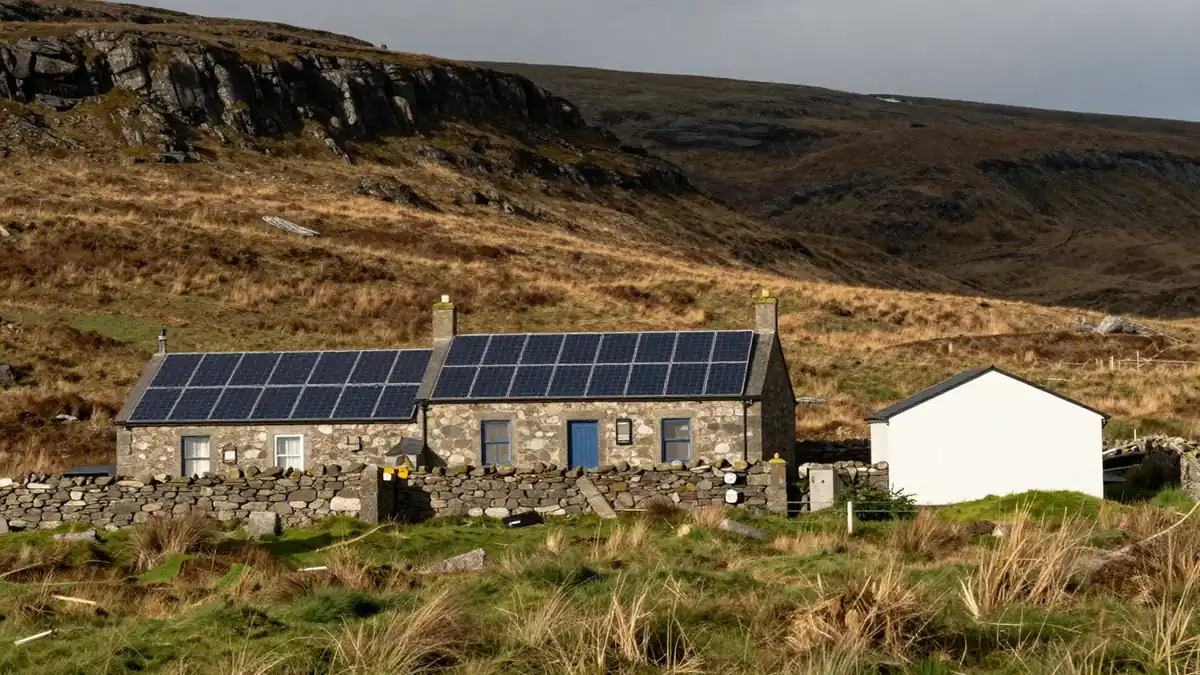
Off-grid solar battery backup keeps chosen circuits running when the grid fails. A standard grid-tied system usually shuts down in a power cut, so backup needs extra hardware. That means a battery with a suitable inverter and a backup gateway, sized for essential circuits rather than the whole house.
Off-grid and backup are different things
People use “off-grid” for two quite different set-ups. A truly off-grid home has no grid connection at all. Because it makes and stores all its own power, the system must cope with the darkest week of winter.
A backup system is more common in the UK. Your home stays connected to the grid, and the battery steps in when the network drops out. Therefore you keep the normal savings from solar and a battery, and gain cover for the circuits that matter most.
For most households this second route is the sensible one. A fully off-grid build needs far more panels and storage, and many owners still add a generator. If you are weighing it up, our off-grid backup service guide sets out the options in more detail.
What keeps running in a power cut
Many solar and battery systems switch off during a power cut. Backup power is an extra feature, so ask your installer whether the system you are quoted includes it. However, do not assume that a battery on the wall will keep the lights on.
The reason is partly safety. Grid-tied equipment normally stops exporting when the network goes down, because engineers working on the lines must not be put at risk. A backup gateway lets your home separate from the grid and run on its own supply.
Once that separation happens, the battery and inverter feed only the circuits you have chosen. The rest of the house stays dead until the grid returns. That is why the choice of circuits matters so much.
Choosing your essential circuits
Start by listing what you cannot live without for a day or two. For example, most homes include the fridge and freezer, lighting, the broadband router, phone charging and the boiler controls. Some people add a medical device, a well pump or a home office.
Heavy loads are different. An electric shower, an oven, a hob, an immersion heater and an EV charger can drain a battery in hours. In contrast, lighting and a router barely register.
Your installer will usually move the chosen circuits onto a separate board. This is a small job, yet it must be done carefully. As a result, you should expect it to appear as its own line in the quote.
Sizing the battery for those circuits
Sizing has two parts: energy and power. Both matter, since a large battery with a small inverter still limits what you can run. Energy, in kilowatt hours, tells you how long the battery lasts. Power, in kilowatts, tells you how many appliances can run at the same moment.
Here is an illustrative method, not a quote. List each essential appliance with its power and the hours it runs. Multiply to get kilowatt hours, then add them up. For instance, if your essential circuits use 6 kWh over a day, a battery well above that figure gives you a buffer.
Next, add up the power of all the loads that could switch on together. A kettle and a freezer starting at once can exceed what a small inverter can supply. Therefore the inverter rating matters as much as the battery size. Our guide to how solar inverters work explains the difference between string, micro and hybrid types.
Where the solar panels fit in
Panels extend the backup during daylight. Still, a cloudy winter day may recharge the battery only a little. Plan the battery to carry your essential loads through the evening and overnight, and treat the sun as a bonus.
Yield varies by place. The European Commission’s PVGIS tool puts a 4 kWp array in Glasgow at about 3,410 kWh a year. It gives about 3,611 kWh in Edinburgh and about 3,793 kWh in Newcastle, while Plymouth reaches about 4,488 kWh. These are modelled annual totals, so winter output will be far lower.
If you already have panels, you may not need a new array. Many homes add a battery to an existing system. Our guide to adding a battery to existing solar covers when that works. In particular, check whether your current inverter can support backup, since many older units cannot.
Where the battery can go
Siting matters for safety. PAS 63100:2024 is a BSI specification for fire protection of home energy storage, developed with UK government sponsorship. It says to install outdoors where practicable.
Indoors, a battery should not sit in a room where people sleep or on an escape route. It should also stay at least 2 metres from stored flammables or fuel. MCS notes that the standard has no standing in UK regulations. However, the IET Code of Practice says installers should use it to choose a battery location.
In practice, a garage or an outbuilding often works well. Your installer should explain where yours will go and why. Since siting affects safety, ask if a quote does not mention it at all.
Planning and paperwork
In England, most rooftop solar on houses and flats does not need planning permission, although conditions apply. For a battery, the position matters more than the panels, so ask your installer or council. Rules changed in England on 27 August 2026, and your installer should confirm what applies to your home.
Scotland has its own rules. The Scottish Government’s Circular 1/2024 says solar panels on a house are generally permitted development outside listed buildings and World Heritage Sites. In a conservation area, panels may go only on a rear elevation or a side elevation not facing a road. A building warrant may still apply.
This matters in tenement cities. About 73% of Glasgow dwellings are flats, according to Glasgow City Council data from 2020. Edinburgh’s 2022 census figures show about 56% of households in flats, and the city has 50 conservation areas. Anyone in a shared building should speak to neighbours and the council first.
Our pages on solar battery installers in Glasgow and home batteries in Edinburgh cover the local picture. Further south, Newcastle has 12 conservation areas and 32.3% of households in flats, based on the 2021 Census. Plymouth has 15 conservation areas, while 25.4% of its households are in flats. If you live in either, read about battery storage options in Newcastle or solar and battery advice for Plymouth first.
Backup and tariffs together
Backup does not stop a battery earning its keep. A battery can still store cheap overnight power and cover the evening peak. Our guide to Octopus battery storage tariffs shows how time-of-use pricing works alongside a battery.
You can also sell surplus solar power. The Smart Export Guarantee needs an MCS-certified system and a smart meter. Read how the Smart Export Guarantee works with a battery before you choose a tariff.
A backup reserve does cost you something. If you hold part of the battery back for emergencies, that energy is not available for tariff trading. Ask your installer whether the system lets you set that reserve level yourself.
Choosing an installer for backup work
Backup is more complex than a basic battery, so installer skill matters. MCS is the UK quality mark for installers and products. Its installers work to MIS 3002 for solar panels and MIS 3012 for home batteries. Our guide to MCS-certified solar installers explains how to check a certificate.
A good quote for backup should list the circuits it covers, the inverter power rating, and the battery capacity. Specifically, it should name the backup gateway, because that part decides what runs in an outage. It should also say where the battery will sit and how the system behaves during an outage. For general battery advice, see our battery storage service page.
Solar Base Energy is a free matching service. We match you with an MCS-certified installer, and the quote form on the site is the place to start. Because the installer needs to price the right system, describe your essential circuits in the form.
Sources
Frequently asked questions
Will my solar panels work in a power cut? +
Many solar and battery systems switch off during a power cut. Backup power is an extra feature, so ask your installer whether the system you are quoted includes it.
Do I need to be fully off-grid to have backup? +
No. Most homes keep their grid connection and add backup for a few essential circuits. That gives you the savings of a grid-tied system and some cover when the network fails.
Should the battery sit indoors or outdoors? +
Siting guidance in PAS 63100 prefers outdoors where practicable. Indoors, a battery should stay out of bedrooms and escape routes, and your installer should explain where yours will go.
Does a backup battery need MCS installation? +
MCS certifies batteries under the MIS 3012 installation standard. You need MCS if you want to claim Smart Export Guarantee payments, so ask whether your installer is certified.